Changes of dehydrated apples
Release time:2026-01-09 17:03:00 Click:
By perfectly aligning with modern consumer demands in three key areas—healthy diets, lifestyle choices, and supply chains—dehydrated apples have evolved from a simple dried fruit into a global food product symbolizing health, convenience, and lifestyle, becoming a bestseller.
About the use of dehydrated apples:
Dehydrated apples are not merely a simple snack, but also a versatile ingredient adaptable to various scenarios. For instance:
l In baking and confectionery, dehydrated apple chunks added directly to cereals, muffins, or cakes can enhance flavor and texture. When rehydrated or mashed to prepare fillings for apple pies or tarts, the resulting flavor profile is more intense than that of jam.
l In daily dining, salads and staple foods can be prepared by sprinkling them on leafy greens or grain bowls to enhance a sweet and crisp texture. They can also be used in stewing and poultry dishes to add a fruity aroma. Additionally, they can be utilized in beverage preparation, such as for brewing fruit tea, or as decorative and flavoring elements in cocktails and non-alcoholic beverages.
l In the field of meal replacement and nutritional supplements, meal replacement powders and nutritional products can be formulated to provide dietary fiber and natural flavors. They can also be rehydrated into apple puree for easier swallowing and digestion. As a natural carbohydrate source in energy gels and protein bars, they offer nutritional support for athletes and are widely popular.
The applications of dehydrated apples have expanded from snacks to multiple dimensions including baking ingredients, catering additives, and functional food bases. Its core advantages lie in: nutrient concentration, extended shelf life, and flexible utilization.
1. Market of Dehydrated Apple in 2025
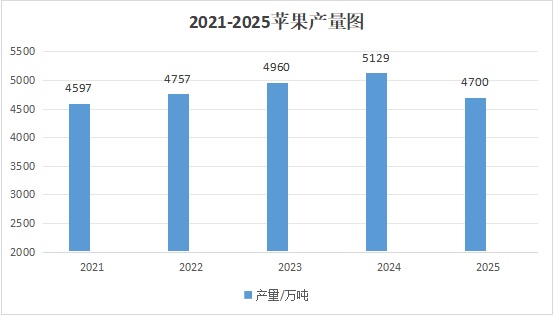
China, as the main production area of apples, has built core advantages in the international market with its huge output, diversified and stable export markets, and continuously upgraded quality and supply chain. However, the apple production in China in the 2025/26 season was lower than the previous four years (2021-2024) overall, reaching the lowest level in the past five years. The USDA official estimate for the 2025/26 season apple production in China is 47 million tons, a decrease of 2.3 million tons (approximately 4.7%) compared to the 49.3 million tons in the (2024/25) season, and slightly lower than the average of 2021-2024 (approximately 47.45 million tons).
China apple production year-on-year in the past 5 years (2021-2025)
2. Reasons for production reduction
• Climate anomalies are the primary influencing factor. Adverse weather conditions in major production areas (spring low temperatures, summer drought, and rainy harvesting periods) combined with reduced planting areas have led to declining fruit set rates and yields, as well as a low proportion of high-quality fruits.
• Some production areas in Shaanxi, Gansu, and Shanxi saw significant output declines, while Shandong recorded a slight increase and Henan boosted production, but these modest gains were insufficient to offset the overall reduction.
3. Market Outlook
Given the complex interplay of multiple factors, the current apple market exhibits highly volatile characteristics. In the short term, supported by tight supply of premium apples, prices are expected to maintain a relatively strong trend. We recommend that customers with demand place orders as early as possible to avoid the peak shipping period following the Spring Festival.
Last one : Low-temperature fried vegetable mix and fruit mix
Next article : Garlic sales and exports from January to June 2026